

A large sculpture for a storefront, a model of a development project, a sign for a trade show booth, or a prototype of a device housing may only look similar at first glance. When asked, “How much does large-format 3D printing cost?” the answer isn’t determined solely by the number of centimeters or the price per kilogram of material. In a professional production process, other factors also matter, such as file preparation, object design, machine runtime, finishing, and safe delivery.
That is why a fair price should not be a single rate “per print.” It should specify exactly what will be produced, to what standard, and for what purpose. A lightweight set piece used for a weekend is designed differently than a durable exhibition piece intended to catch the eye for many months.
How much does large-format 3D printing cost?
For one-of-a-kind, custom-made pieces, the price range is wide. A simple decorative model measuring several dozen centimeters can cost anywhere from about 500 to 3,000 PLN (net). An item approximately one meter tall, requiring the assembly of parts and basic surface preparation, often falls within the range of 3,000 to 10,000 PLN net.
For larger sculptures, functional prototypes, and objects that require painting, reinforcement, or complex assembly, the budget can range from a dozen or so to several tens of thousands of zlotys. This is not an inflated cost for the “large plastic” itself. It is the cost of the process that transforms your vision—from a file or sketch—into a stable, aesthetically pleasing object ready for display.
The lowest price usually means simple geometry, standard material, visible print layers, and no additional finishing. A higher budget allows for better surface quality, precise details, a durable construction, color, varnish, component assembly, and preparation for shipping. It’s worth comparing not only the final price but, above all, the scope of work included in the quote.
What really goes into the price of a large print?
Size, volume, and structure of the facility
Size matters, but there’s no simple rule of thumb here: a model that’s twice as tall doesn’t necessarily cost twice as much. A structure 150 cm tall may need to be divided into multiple segments and require an appropriate connection system and internal reinforcements. If it’s meant to stand on its own, you’ll need to consider its center of gravity, its base, and its resistance to accidental impacts.
A large but simple 3D sign may be faster to produce than a smaller, figurative sculpture with fine details. On the other hand, a thin-walled object may use less material but require greater attention during printing and subsequent assembly. Therefore, the quote takes into account not only the dimensions but also the geometry and anticipated loads.
Status of the 3D model and scope of preparation
A finished file isn’t always ready for printing. The model may have open surfaces, sections that are too thin, incorrect proportions, or details that become invisible after resizing. In such situations, the model needs to be prepared: correcting the mesh, dividing it into parts, adding connectors, designing a base, or modifying the structure to make it more suitable for production.
If you’re starting with a sketch, a reference photo, or a rough concept, 3D modeling will be added to the budget. This is the stage at which it’s worth discussing the object’s function. Will the logo be hung on a wall? Is the sculpture meant to be transported to an event? Does the prototype need to house electronics? The answers to these questions help avoid costly changes once production has begun.
Material and Production Specifications
The choice of material should be based on its intended use. A conceptual model for display in an office has different requirements than an item used outdoors or one that is frequently handled by people. Factors such as mechanical strength, temperature resistance, moisture resistance, weight, and the planned finish are all important.
The cost is also affected by wall thickness, infill density, and layer height. A thicker layer reduces print time and works well for models viewed from a distance. A thinner layer better captures details but extends the machine’s processing time. It’s not always worth paying for maximum resolution. For a large object viewed from several meters away, a well-prepared surface may be more important than microscopic details.
The finish determines how it is perceived
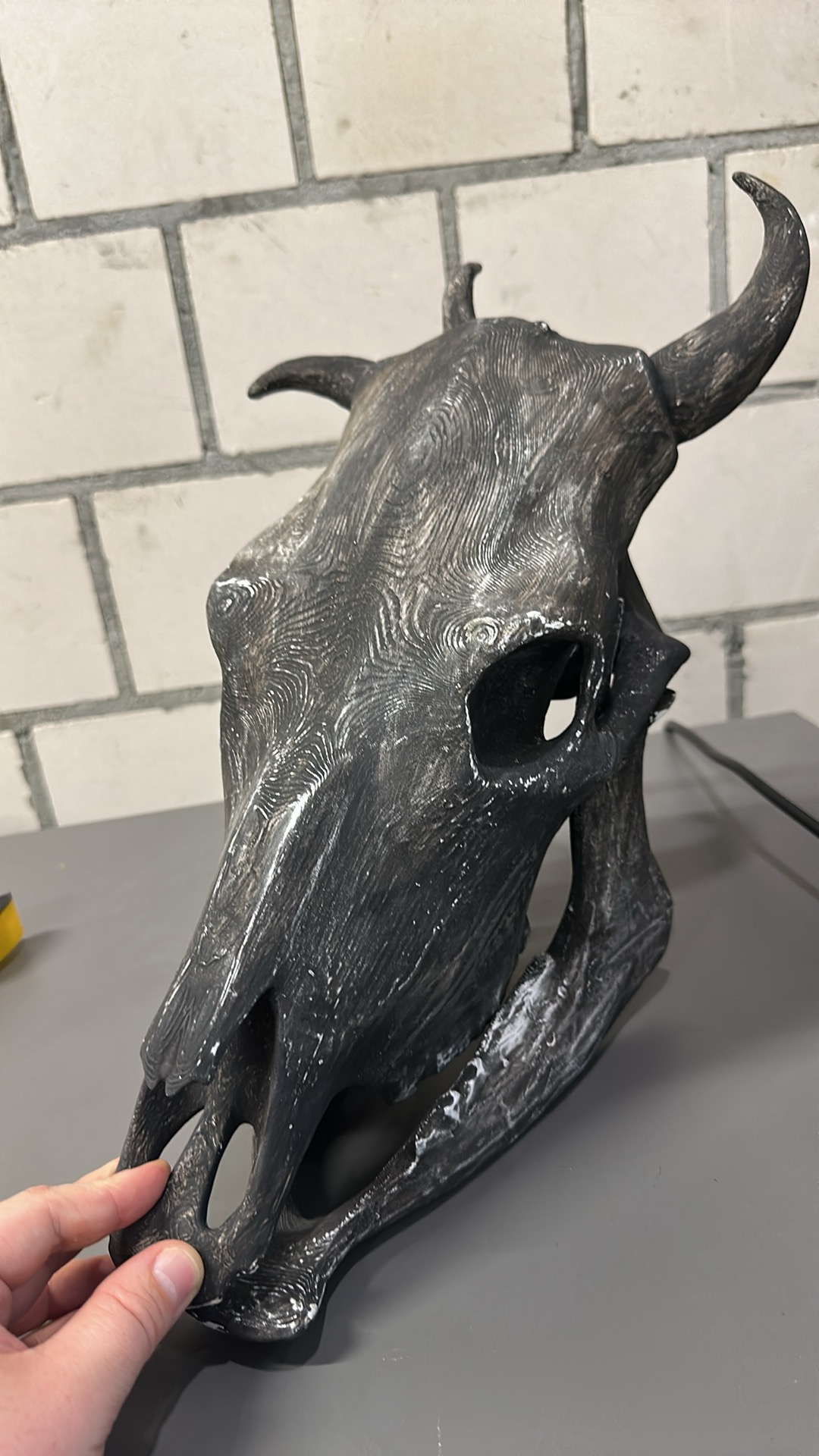
A raw 3D print has a distinct technological character—visible layers and seams can be an asset in modern set design or prototyping. However, if the object is intended to represent a brand at a trade show, in a store, or at a reception desk, it often requires further finishing.
Filling, sanding, priming, painting, and varnishing can account for a large portion of the estimate. The same goes for installing inserts, magnets, metal components, wall mounts, or LED lighting. The final result depends more on the quality of the handwork than on the printing time itself. It’s worth deciding from the start whether your goal is a prototype, an artistic object with visible texture, or a product with a smooth, display-ready surface.
Delivery Time and Logistics
Large-format printing is an ongoing process. A single piece can take many hours—and sometimes several days—to produce. Afterward, it must be stabilized, cleaned, glued, finished, and packaged. When facing a tight deadline, the quote may factor in production priority and the ability to work on several stages simultaneously.
A large item must also be delivered safely. Shipping costs depend on the package’s dimensions, weight, the fragility of the surface, and the destination. A sculpture being shipped abroad requires different preparation than a flat item being picked up locally. Professional packaging is not a trivial detail—it protects the final result of the entire project during transit.
How can you reduce costs without compromising quality?
The greatest savings are achieved before the printers are turned on. If the object is to be viewed from a distance, you can omit fine details that won’t be visible in the final application. When a project does not require a completely smooth surface, it’s worth leaving a controlled print texture rather than investing in time-consuming sanding.
Choosing the right scale also helps. Sometimes a 90-cm-tall logo creates just as strong an impact as a 120-cm version, while being easier to transport and install. If you’re planning a series of identical elements, the cost of designing the project is spread across more units. For illuminated structures, it’s a good idea to provide information right away about the installation location, power supply, and the desired lighting effect.
However, it’s not worth skimping on stability, mounting, and transport protection. These are elements that the customer often doesn’t see, but which determine whether the structure will arrive intact and function as planned.
How do you prepare a brief for a quick quote?
You don’t need technical experience or a ready-made CAD file. For a productive discussion, all you need are: approximate dimensions, a few photos or reference sketches, information about the intended use, the expected deadline, and the finish standard. It’s also helpful to specify whether the object will be used indoors, outdoors, at an event, or in a permanent exhibition.
If you have a 3D model, it’s a good idea to send it along with information about the target scale. If you don’t have one, a description of the features and aesthetics is just as valuable. Based on this, we can suggest the manufacturing technology, production breakdown, materials, and budget options—for example, a rough prototype and a fully finished version.
At Janko Sculptures, our in-house-built and custom-configured 3D printers allow us to tailor production parameters to a specific project, rather than adapting the project to the machine’s arbitrary limitations. This provides greater control over scale, detail, and repeatability, especially for custom projects.
The best place to start isn’t by asking about the price per kilogram of material, but by defining the purpose the installation is meant to fulfill. Once you know what your project is meant to communicate, where it will be located, and how long it will contribute to the brand’s image, the pricing becomes a concrete action plan rather than a matter of guesswork.